


THE OCEAN CLEAN UP
- Sep 5, 2018
- 4 min read

Waste in our oceans has been and is still is a great threat to marine life. In one of my previous blog post titled "Marine vs Plastics" i have talked about how plastics are affecting marine life and pushing the endangered marine species such as sea turtles, seagulls, seals and sea lions closer to extinction. Environmentalist around the world have taken note of the ever growing number of plastics getting into our oceans. Numerous efforts have been made both by non- governmental and governmental organisations to remedy the situation through beach cleanups,encouraging reduction,reuse, recycling of plastics and educating coastal communities.
"What if there were an even better way to clean the oceans?". These were the words spoken by Boyan Slat, the CEO and founder of The Ocean Clean-up. So what is the ocean clean up?
The Ocean Clean-up is a non-govermental organisation founded in 2013. The company aims to get rid of ocean plastic starting with the largest accumulation of ocean plastic in the Great Pacific garbage patch.
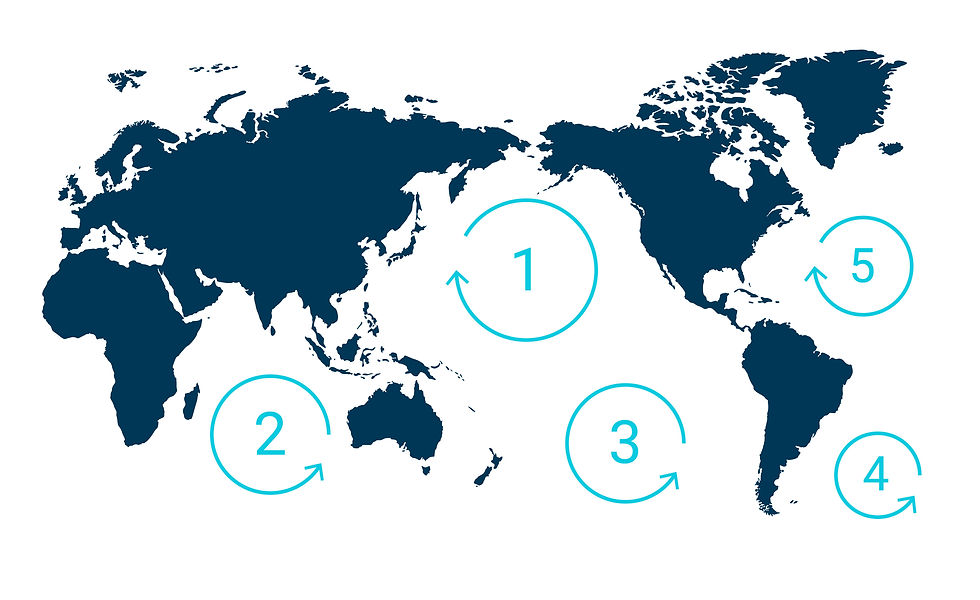
Ocean currents concentrate plastic in five areas around the world. These concentrations of plastics are called garbage patches but if you want to add a scientific feel to it they are as well called sub-tropical gyres. Ocean plastic covers millions of square kilometers and travels in all directions. The greatest accumulation of ocean plastic as mentioned earlier is the Great ocean pacific garbage patch. This is a region between Hawaii and California(labelled 5 on the image below)

We have to understand that plastics in our oceans will not go away on its own. It simply needs to be cleaned up or else it will become unmanageable. Plastic decompose very slowly. To demonstrate this i will give a simple example;A crate dated 1997 was collected from the ocean last year and is still intact. The plastic looks more so the same. When plastic in the ocean is exposed to sunlight it becomes brittle and therefore forms micro-plastics which are more dangerous to marine life.(Read about micro-plastics and its dangers in my previous blog post "marine vs plastic). Given that more and more plastic is still being dumped into our oceans a simple calculation shows that this will in turn lead to greater amounts of micro-plastics overtime. This is what makes the ocean clean up project very essential.
The great pacific garbage patch has about 1.8 trillion pieces of plastic. The ocean clean up aims to clean 50% of it in 5 years time. How will they manage to clean so many pieces of plastic in search a short time given that the area is not even on land but hundreds of miles offshore?
Boyan Slat together with a team of scientists have come up with a simple yet brilliant solution to undertake the project. Before i get into details on how it will be done it is important to note that just like any other invention the ocean clean up system designed underwent multiple tests and failures. The team of scientists undertook reconnaissance missions to determine;
To what depth the ocean needs to be cleaned up, which is 10m.
The scientists criss-crossed the great ocean pacific garbage patch with 30 vessels at the same time to produce the first high resolution map of the area.
They conducted numerous scale-model experiments replicating ocean conditions such as waves, currents and winds to better design the concept.
Finally the team was able to come up with a prototype launched in the North sea successfully.
The ocean clean up system is what i call a nature-based solution. It is a solution to an environmental problem where natural conditions are used to remedy an environmental problem(in this case plastic waste). The ocean clean up system is composed of U- shaped screen channels floating plastic to a central point. The system consists of 600 m long floater and a 3 meter deep skirt attached below.The floater prevents plastic from flowing over it while the skirt prevents plastic from escaping underneath. The skirt is impenetrable therefore marine life can move below it without getting entangled in the system. Each system has been designed to store and transfer large amounts of data relating to navigation, environmental conditions,operational status, and integrity. The sensors are linked to 5- solar powered electronic pods mounted on the system.


The system is comprised of;
Two satellite pods, to enable system to remotely send and receive data such as GPS locations from headquarters in Rotterdam, Netherlands.
One Camera pod with high definition cameras that turn 360 degrees and give visual feedback.
Two navigation pods which carry a complete weather station and Automatic Identification System for it to be recognized by sea vessels.
Nine lanterns to ensure visibility. The lanterns also feature radar reflectors for added detectability.
Both the plastic and the system are propelled by the wind and waves. This is because the system is not anchored to the seabed but its anchor hangs some meters under the sea level to make the system mobile. This is important for two reasons. One is that the drifting system is able to move to areas where plastic is most concentrated as the same forces moving the plastic are moving the system. This in turn means more plastic can be collected than if the system was anchored to a single spot in the sea. Two is that the survivability of the system is increased as it absorbs less force from ocean currents due to its mobility.

The ocean clean up is composed of multiple clean-up systems which make clean up faster . Once enough plastic has been collected the sensors will send a message to the team on shore and using the navigation system the system is tracked by a ship which collects the plastic and brings it on shore where it can be recycled. The first ocean clean up system named " Wilson" is to be launched on September 8th.

Bringing it home(Kenya) there exists an Ocean garbage patch off our coast which is growing. Employing such systems at an early stage will make clean-up so much easier and faster. By borrowing the innovation by Boyan Slat we could get rid of plastics in our oceans before its too late.
You can follow the ocean clean up on Facebook and twitter @ The Ocean Cleanup to get updates on the launch and learn more about the project.
Visit their website www.theoceancleanup.com
Comments