


THE EXTINCTION SERIES: Sumatran rhino
- Jun 3, 2019
- 4 min read

The term extinction has now become a commonly used word among environmentalists more so those concerned with wildlife. On my very first post I talked about Sudan who was the last male rhino who unfortunately died on due to age related complications. I also pointed out that previously the world has experienced 5 mass extinctions this being the 6th one.
On May 27th 2019 Tabin Wildlife reserve announced the death of Tam who was the last male Sumatran rhino left in captivity.
There are five species of rhino: white rhino, black rhino, Sumatran rhino, greater one horned rhino (or Indian rhino) and Javan rhino. Due to the demand for rhino horn from Asian countries including Vietnam and China driving an unprecedented level of rhino poaching and loss of rhino habitat, all rhinoceros are facing the very real possibility of extinction, with the black, Sumatran and Javan rhinos listed as critically endangered by the IUCN.
Below are some key rhino facts with more information on a dedicated page for each of the five rhino species. This information about rhinos will help you get to know more about these iconic animals.

Sumatran Rhino (Diceohinus sumatrensis)
Closest living relative to the wooly rhinos. Only species to still be covered in hair.
IUCN Status: Critically Endangered
Population: Less than 100
Habitat: Tropical and subtropical forests
Weight: 550kg to 1,000kg
Distribution: Sumatra, Sabah

Black Rhino (Diceros bicornis)
Africa's smallest species of rhino, also known as the 'hook lipped rhino'
IUCN Status: Critically endangered
Population: 5,000 to 5,500
Habitat: Tropical grassland, Shrublands, deserts
Weight: 900kg to 1,400kg
Distribution: South Africa, Namibia, Zimbabwe, Tanzania, Kenya

White Rhino (Ceratotherium simum)
Africa's largest species of rhino, also known as the 'square lipped rhino'
IUCN Status: Near Threatened
Population: 20,000 to 22,000
Habitat: Grassland and savanna
Weight: 1,800kg to 2,700kg
Distribution: South Africa, Namibia, Botswana, Zimbabwe, Zambia, Kenya, Uganda

Javan Rhino (Rhinoceros sondaicus )
All Javan rhinos in the world survive in Ujong Kulon National Park.
IUCN Status: Critically Endangered
Population: 67
Habitat: Tropical and subtropical forests
Weight: 900kg to 2,300kg
Distribution: Sumatra, Sabah

Great Horn Rhino (Rhinoceros unicornis)
Asia's largest species of rhino, also known as the 'Indian rhino'
IUCN Status: Vulnerable
Population: 3,300 - 3,600
Habitat: Tropical grassland, shrublands, savanna
Weight: 1,800kg to 2,700kg
Distribution: India, Nepal
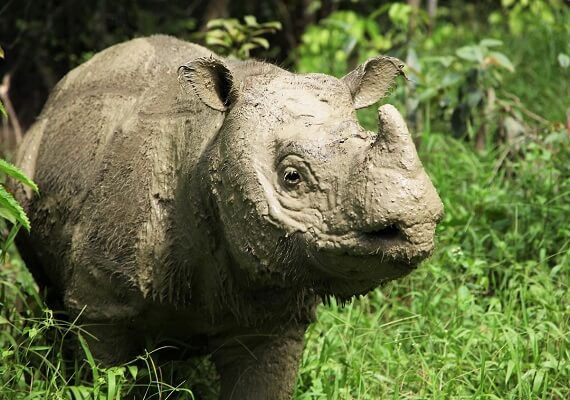
Discovered poking around an oil palm plantation in 2008, Tam was captured and transferred to the Tabin Wildlife Reserve in the state of Sabah. Efforts to breed him with two female rhinos—Puntung, captured in 2011, and Iman, captured in 2014—proved unsuccessful.
With Puntung’s euthanization in 2017 due to cancer, Iman is now the nation’s sole remaining member of its species in Malaysia. Due to decades of habitat loss and poaching, fewer than 80 Sumatran rhinos are thought to exist in the wild, most on the nearby island of Sumatra. The rest are scattered across Kalimantan in Indonesian Borneo.
Sumatran rhinos are so few, in fact, experts now believe isolation is the single biggest threat to the species’ continued existence. This is because females of this species can develop cysts and fibroids in their reproductive tracts if they go too long without mating. (Such was the cause of Iman’s infertility. Puntung's inability to carry fetuses seemed to stem from injuries sustained from a poacher’s snare and a failed pregnancy in the wild.)

That's why, in 2018, the world’s leading conservation nonprofits, including the National Geographic Society, announced an unprecedented collaboration called the Sumatran Rhino Rescue. The aim? To find and safely capture as many wild rhinos as possible so that they can be brought together for captive breeding.
Tam’s condition had been steadily declining since late April, when his appetite and alertness declined, Sabah Wildlife Department director Augustine Tuuga told Malaysian newspaper The Star. Urine tests revealed that the rhino’s kidneys and perhaps other organs had begun to fail.
Authorities can’t say yet why Tam deteriorated so quickly, but it may simply have been old age. Tam was estimated to have been in his thirties, and these animals only have a life expectancy of 35 to 40 years.
Unfortunately the remaining two females at Tabin were unable to carry fetuses. This is because the two females have stayed long without mating then they develop cysts.
While Tam wasn’t able to produce any offspring on his own, his presence in captivity did help us better understand his kind.
The work that the Borneo Rhino Alliance did with advanced reproductive techniques, especially harvesting eggs and attempting to create embryos, took us one step further towards understanding of the species’ biology,” says Susie Ellis, executive director of the International Rhino Foundation.
As tragic as Tam’s death is, it's a wakeup call to find more animals in the wild.The good news is that late last year the coalition had already succeeded in capturing a new female, named Pahu. Her transfer to a new breeding facility in Kelian was so important, the rhino was afforded an escort from both police and mudslide-clearing bulldozers. (Read: “First wild Sumatran rhino captured in urgent bid to save species.")
So far as experts can tell, Pahu does seem to be reproductively healthy, she is thriving in her new home, and, with any luck, she may soon have company.
Recent surveys indicate there are other rhinos still roaming in Kalimantan's forests," "which gives me renewed hope."“We need to continue to be laser-focused on saving the remaining 80 Sumatran rhinos, using a combination of intensive protection and captive breeding, and working with local people to instill pride that the rhino is part of their biological heritage,” says Ellis. “This is a battle we cannot afford to lose."
Comments