


THE CAT MONKEY
- Nov 18, 2019
- 4 min read

Common name: clouded leopard
Scientific name: Neofelis nebulosa/ Neofelis diardi
Conservation status: vulnerable
Type: mammal
Diet: carnivore
Lifespan: 17 years
Here are some fun facts before you begin!
In China the clouded leopard is known as the 'Mint Leopard' because its spots also look like mint leaves.
There are not one but two species of clouded leopards.
Clouded leopards are able to climb trees upside down.
Clouded leopards are difficult to breed in captivity due to their aggressiveness.
They have the longest canines of any big cat and are closely linked to the saber-toothed tiger.
Taxonomy
Clouded leopards are two species of wild cat that live throughout the forests of Southeast Asia. Until 2006, there was thought to be a single clouded leopard species. However, recent genetic and morphological research has shown that there are two distinct species. The cats on mainland Asia and Taiwan kept the traditional species name (Neofelis nebulosa) while the cats from Borneo and Sumatra took the name the Sunda clouded leopard (Neofelis diardi)

Description and adaptation
Clouded leopards are a medium-sized cat named for the cloud-like spots on its coat. These provide camouflage in the dappled light of its forest habitat. The cats usually stand 10-16 inches (25-40cm) tall and are 4 to 6 feet (1.2-1.8m) long, almost half of which is the tail. Males tend to be larger and weigh up to 23 kg (50 pounds), while females rank in at about 16kg (35pounds). Clouded leopards can live to about 17 years old in captivity.
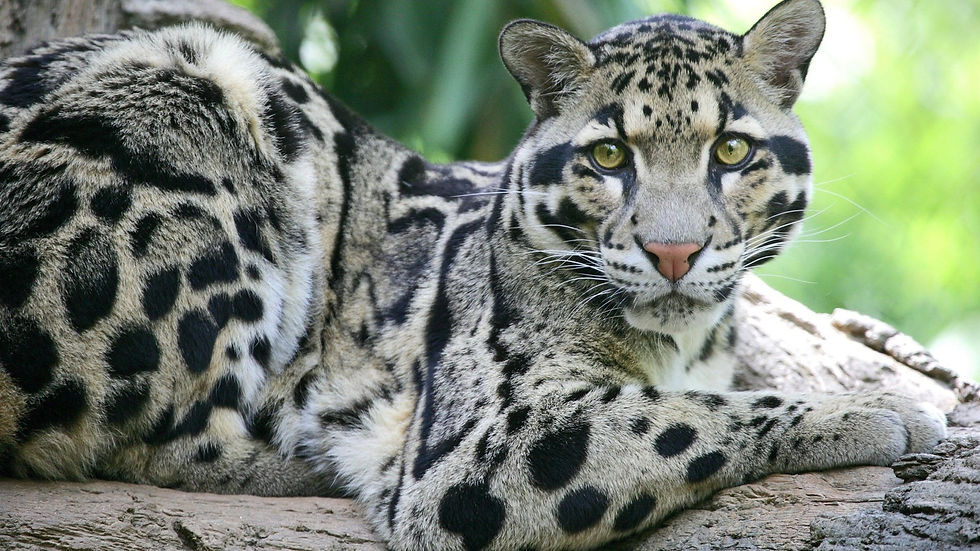
Fitting for an arboreal creature, clouded leopards are one of the best climbers in the cat family. They are able to climb upside down underneath tree branches, hang from branches with their hind feet, and even descend head first, like a squirrel. Several adaptations allow clouded leopards to achieve these amazing arboreal skills. Their legs are short and stout, providing leverage and a low center of gravity. Furthermore, a clouded leopard's extremely long tail provides an excellent balancing aid. For grip their large paws are armed with sharp claws and specialized padding that conforms to the shape of the branch. The hind feet possess flexible ankle joints that allow the foot to rotate backwards as well. With such fine skill sets and adaptations thats why i refer to the clouded leopard as the cat monkey. It is built for the trees.
Another distinctive feature of the clouded leopard is its long canine teeth and unusual skull. The clouded leopard has the longest upper canine teeth for its skull size of any modern carnivore, causing some people to compare the cat with the extinct saber-toothed cat (read about the saber toothed cat in previous blog posts). In fact, studies by Dr. Per Christiansen of the Copenhagen's Zoological Museum have revealed connections between the two groups. Dr. Christiansen's research into the skull characteristics of both living and extinct cats has revealed that that the structure of the clouded leopard skull bears distinctive resemblance to primitive saber-toothed cats such as Paramachairodus (before the group became highly specialized and developed enormous upper fangs). Both saber toothed cats and clouded leopards have an enormous gape, around 100 degrees, and various adaptations to support such a gape. In contrast a modern lion can open its mouth about 65 degrees. This could indicate that one lineage of modern cats, of which now only the clouded leopard is still present, evolved some adaptations in common with the true saber-toothed cats.

It also indicates that the clouded leopard may hunt large prey in the wild in a slightly different manner from other great cats. Saber-toothed cats would bite prey through the neck, using their elongated teeth to sever nerves and blood vessels and strangle the windpipe, which would instantly kill the prey. It is possible that clouded leopards use a similar technique. However, little is known about clouded leopard hunting strategies and no current evidence points to an unusual feeding ecology
Reproduction
Clouded leopards are sexually mature around the age of 2 years. Mating can occur in any month, but in captivity most breeding occurs between December and March. The gestation period is 85 to 93 days long with 1 to 5 cubs per litter, although 2 is the most common number. Females can produce a litter every year. Cubs become independent at approximately 10 months of age.

In captivity, clouded leopards present a reproductive challenge. Unfortunately, there is a high incidence of aggression between males and females, sometimes resulting in the death of the female. This has made clouded leopards one of the most difficult cats to breed in captivity. Present captive management practices include introducing the members of a pair prior to one year of age. This practice has resulted in the establishment of more successful pair-bonds and lessening of aggression. Behavior
Like all wild cats, clouded leopards are carnivores. They are thought to hunt a variety of prey including birds, squirrels, monkeys, deer, and wild pigs. It was once thought that clouded leopards hunted while climbing. Current thought, however, is that while some hunting may occur in the trees, most takes place on the ground. Trees are thought to provide resting habitat for cloudeds during the day. Virtually nothing is known of the social behavior of wild clouded leopards. They are likely solitary, like most cats, unless associated with a mate while breeding or accompanied by cubs. Likewise, activity patterns are virtually unknown. Once thought to be exclusively nocturnal, evidence suggests that cloudeds may show some periods of activity during the day as well. It is known that they will patrol their territory (like all cats) and may use logging roads for hunting and travelling. Territories range from about 20-50 km.
Threats
Clouded leopards are classified as an Appendix I endangered species by CITES, which means that international trade is prohibited. The IUCN classifies clouded leopards as vulnerable. They are protected from hunting in range countries, although wildlife laws are rarely enforced in most areas. Clouded leopards face many significant threats in their Southeast Asian homeland. Their forest habitat is experiencing rampant degradation due to industrial logging and the development of agricultural areas, including vast palm oil plantations in Malaysia and Indonesia. These degraded areas cannot support prey species nor provide habitat for clouded leopards. In addition, the clouded leopard and its prey are targeted by both commercial and subsistence hunters. Because larger wild cat species such as tigers and leopards have mostly been hunted out of their range, clouded leopards are increasingly becoming the targets of commercial poachers seeking their skins, bones, and meat.

Comments