


THE TIDE, LIGHT IN THE DEEP
- May 19, 2020
- 5 min read
The flashlight, streetlight, headlights, bulb and candle have one thing in common they all emit light. Scientists like Benjamin Franklin who invented electricity have been praised for the invention that changed life on earth. Humans may have been intrigued by this new invention but our animal counterparts have for centuries developed the ability to produce light for themselves. However, unlike us they use their light which is called bioluminescence, for various purposes. Lets dive in and learn how and why they do it.

Jelly fish showing bioluminescence
How its made?
According to national geographic a whopping 76 percent of ocean animals are bioluminescent, which means they produce their own light through a series of chemical reactions or host bacteria that do. It’s a separate process from biofluorescence, in which blue light hits the surface of an animal and is reemitted as a different color, usually orange, red, or green.
Bioluminescence occurs through a chemical reaction. For bioluminescence to occur two tings must be present luciferin and oxygen. That’s because luciferin plus oxygen equals bioluminescence light. Animals that have luciferin can therefore emit bioluminescent light. Some even produce an enzyme, luciferase, which acts as a catalyst.
Animals can closely control when they light up by regulating their chemistry and brain processes depending on their immediate needs, whether a meal or a mate. Some organisms even bundle the luciferin with oxygen in what is called a “photoprotein”—like a pre-packaged bioluminescence bomb—that is ready to light up.They can even choose the intensity and color of the lights.
What Color is Bioluminescence?
Light travels in waves of different shapes—known as wavelengths—which determine the color of the light. When the waves hit our eyes, they are translated into colors by the brain depending on their wavelength. The wavelengths that our eyes can see are known as the "visible light spectrum," and we can see all the colors on this spectrum as they travel through the air above land. But light travels differently underwater because longer wavelengths can't travel as far. Most of the bioluminescence produced in the ocean is in the form of blue-green light. This is because these colors are shorter wavelengths of light, which can travel through (and thus be seen) in both shallow and deep water.
Light traveling from the sun of longer wavelengths—such as red light—doesn't reach the deep sea. This is why many deep sea animals are red: it's effectively the same as being invisible. But that doesn’t mean they are safe ! Some animals evolved to emit and see red light, including the dragonfish (Malacosteus). By creating their own red light in the deep sea, they are able to see red-colored prey, as well as communicate and even show prey to other dragonfish, while other unsuspecting animals cannot see their red lights as a warning to flee.
Who makes it?
Bioluminescence is found in many marine organisms: bacteria, algae, jellyfish, worms, crustaceans, sea stars, fish, and sharks to name just a few. In fish alone, there are about 1,500 known species that luminesce. In some cases, animals take in bacteria or other bioluminescent creatures to gain the ability to light up. For example, the Hawaiian bobtail squid has a special light organ that is colonized by bioluminescent bacteria within hours of its birth. But usually, the animal itself contains the chemicals necessary for the reaction that produces bioluminescence.

pic:bioluminescent bacteria
What is it for?
Feeding
Animals can use their light to lure prey towards their mouths, or even to light up the area nearby so that they can see their next meal a bit better. Sometimes the prey being lured can be small plankton, like those attracted to the bioluminescence around the beak of the Stauroteuthis octopus. But the light can also fool larger animals. Whales and squid are attracted to the glowing underside of the cookie-cutter shark, which grabs a bite out of the animals once they are close. The deep-sea anglerfish lures prey straight to its mouth with a dangling bioluminescent barbel, lit by glowing bacteria.

pic:Stauroteuthis octopus

pic:cookie cutter shark glowing underside

pic: representation of angler fish
Attracting Mates
Syllid fireworms can be found mainly on the seafloor, but they switch to a planktonic form to reproduce, where the females use bioluminescent signals.

Syllid fireworm
bioluminescence can also play a part in attracting a mate. The male Caribbean ostracod, a tiny crustacean, uses bioluminescent signalson its upper lips to attract females.
Anglerfish, flashlight fish and ponyfish all are thought to luminesce in order to tell the difference between males and females, or communicate in order to mate.
Defensive Adaptations
Often animals use a strong flash of bioluminescence to scare off an impending predator. The bright signal can startle and distract the predator and cause confusion about the whereabouts of its target. This tactic can be very useful in the deep-sea.Many species of squid, for instance, flash to startle predators, such as fish. With the startled fish caught off guard, the squid tries to quickly escape.
The vampire squid exhibits a variation of this defensive behavior. Like many deep-sea squid, the vampire squid lacks ink sacs. (Squid that live near the ocean surface eject dark ink to leave their predators in the dark.) Instead, the vampire squid ejects sticky bioluminescent mucus, which can startle, confuse, and delay predators, allowing the squid to escape.

pic: Vampire squid
Many marine species use a technique called counterillumination to protect themselves. Many predators, such as sharks, hunt from below. They look above, where sunlight creates shadows beneath prey. Counterillumination is a type of camouflage against this predatory behavior.
Hatchetfish use counterillumination. Hatchetfish have light-producing organs that point downward. They adjust the amount of light coming from their undersides to match the light coming from above. By adjusting their bioluminescence, they disguise their shadows and become virtually invisible to predators looking up to the surface.
Some bioluminescent animals, such as brittle stars (picture below), can detach body parts to distract predators. The predator follows the glowing arm of the brittle star, while the rest of the animal crawls away in the dark. (Brittle stars, like all sea stars, can re-grow their arms.) When some animals detach body parts, they detach them on other animals.

When threatened, some species of sea cucumber can break off the luminescent parts of their bodies onto nearby fish. The predator will follow the glow on the fish, while the sea cucumber crawls away.
FUN FACTS
Bioluminescence is also called "cold light." Cold light means less than 20% of the light generates thermal radiation, or heat.
It’s so important, in fact, that the trait has evolved 27 times among ray-finned fishes, a huge group that makes up half of all vertebrate species alive today.
Fresh water fish cannot emmit biolumenescense as they cannot tolerate low salinity.
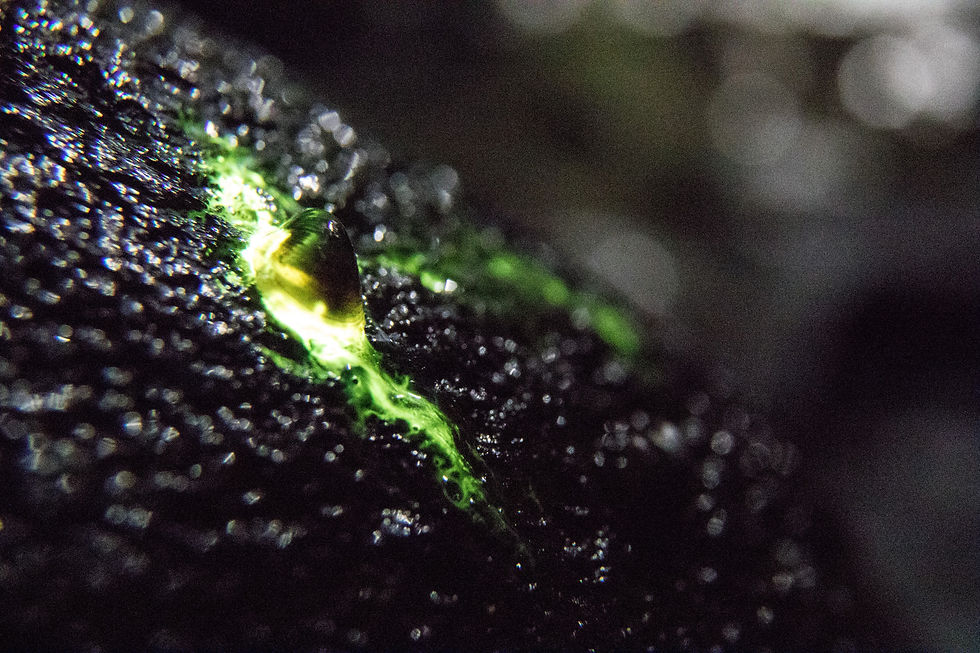
The only instance of bioluminescence in a freshwater animal is Latia neritoides, a limpet-like snail native to New Zealand streams, where it emits a glowing slime when bothered. (picture below)
Comments